

Who are our National Council members and what do their roles involve? Our series will cover each of our heads of departments and their involvement in our sport from the time they first bowled to what’s in store for the future.
We start with one of our longest serving members, Meet Paul LeManquais
Let’s start at the very beginning and ask how you first met bowling and why did you get into the sport?
I first got into bowling aged 13 when I was invited to what was, I suppose in modern day terminology, a bowling birthday party for a school friend. It was a long way from what children can get these days! It was at the Ambassador Lanes bowling centre in Portsmouth where my school friend had bowled before and was already a member of their YBC. I was pretty much hooked at that point and after a few more visits and games I joined the YBC.
Who helped you in those early years as you progressed and where did you learn?
There were no real instructors in in the league those days that I recall, just the willing but important bunch who ran the league. I pretty much taught myself, something I would not recommend as some unwelcome habits started early as a result.
Keith Hale drilled my first ball, and I used it at the NAYBC Nationals at Wembley Stadium Bowl. I gradually improved. My YBC career wasn’t initially of any real note but as the time went by, I improved and in 1973 recorded three house records, junior High Series along with the doubles High Game and Series for which I still have the Ambassador Record Holders Club cards.
UK Hall of Fame records show your biggest achievement came as a Youth in 1974 and winning the coveted British Matchplay and also a Coca Cola Singles title that same year. At this point did you see working in the sport as a possible career in your future?
My first significant tournament was the London Junior Matchplay, at the Airport Bowl in 1974. I beat Roger Bass in the final with series of 567, I think!
My next success in the same year was the Ambassador Bowling Coca-Cola Under 21 tournament. The final was at Lewisham which if I recall you had to qualify for through your home centre. I still have the perpetual trophy as this was the last time it was ever run.
Like many young bowlers I always imagined working in the industry, but I was in an MoD apprenticeship, and I saw that as important to complete. That said my fascination with machinery and lanes, especially the AMF 82-30 pinspotters at Portsmouth, saw me get a part time job working there at weekends.
How did you get involved more with the local and national association?
In 1974 aged 18, I took on my first league secretary’s role, a job I have had done continuously ever since. It was totally paper based then. The introduction of computerisation made that easier in the mid 1980’s but as many centres now have no back office facility, the league sheet once again involves manually feeding scores into the software.
I was asked to become the Hampshire BTBA area secretary in the 1980’s and did this for over ten years. I resigned as a matter of principal after I was suspended from the role by the then Head office, but I see their logic now. My crime was supporting a centre manager who wanted to have all the leagues sanctioned. Another centre manager complained about my tactics and that was that.
Having disagreements with our National Association has been common since the very beginning and it’s good that people like yourself do not just walk away and work things out. How has the Association changed over the years?
The BTBA has had knocks in the past. It will never be perfect for all, as we all have different views of how we think it should operate. Those who criticise need to understand that it is run, at least now totally by volunteers both at county and national level. The opportunity to help is always there. All National Council posts have a defined time period. Eligible posts are then advertised and applications invited. Sadly, applicants can be few and far between.
Now long been the Head of technical services and making sure our sport stays honest, what does your role involve?
I continued to absorb knowledge about the technical side of lanes and pinspotters, so when a lane Inspectors course was advertised, I jumped at it. It was run at what is now NAMCO Norwich. Having successfully passed I was given a number of centres to inspect. My intentions at the outset and still are, was to help improve things for bowlers. One centre, now closed, aside, that was pretty much the case year on year. Pin spotting was my number one annoyance and the ‘one centre’ was particularly bad.
One day after another horrid inspection there, where just 10% of the pins were on spot, the duty receptionist asked what I had been doing. They then added, from 30 meters away, I assume that lane is one where the pin spotting is bad. They were right, but it was one of many, enough said. It never got any better.
Some inspectors were involved with taping lanes before and during sanctioned tournaments to assure conformity of oil patterns squad to squad. Modern lane machines are trusted to do this now , so it is hardly ever done anymore.
I have been inspecting lanes now for 30 years. When I was asked if I would be prepared to take over as Head of Technical Services, I was delighted to do so and agreed. That was ten years ago. I have also qualified on both the ETBF Technical Certification and Lane Maintenance Programs.
The inspector’s team collectively developed a spreadsheet where all measurement are inserted and from these a grade is automatically produced. The spreadsheet is regularly reviewed and adjusted.
The remit all inspectors have is that we should not be viewed as just ‘people with clipboards’. We record only what we see and measure, and to then help tech staff understand what is required and how they may best achieve that.
The Head Tech role is advertised every three years, and open for anyone to apply. It involves all the administration of getting authorisation to inspect the centre for the inspectors, handling invoicing updating the website and then storing and preparing the final report to send to them once the invoice is paid. This gives guidance as to how improvements can be made and a higher grade achieved.
With the introduction of string pinsetters our playing rules had to be adjusted specifically on legal and illegal pinfall. This fell to me and was later shared with the Dutch federation at their request.
Head Tech is a permanent position on the National Council. Technical issues aside, I also administer the Annual Awards process, update on behalf of the responsible council member, the BTBA rules, both general, league and technical, and along with the ICC rules.
Why should a bowling centre be sanctioned, is it a big cost to proprietors?
It is often questioned why a bowling centre should be sanctioned? For our members sanctioning indicates the centres overall standard and hopefully a better bowling experience, something which is fundamental in our aims. The lane certification process acts as an independent health check of the proprietor’s lanes. The biggest investment within a bowling centre are the lanes and pinsetters. Any underlying issues, which are not checked as part of day to day or routine maintenance by Technicians, can be found. Problems can then be identified before they become too serious. It is even more relevant now that technician numbers are reduced and therefore even less time available to them. It is a sound investment in the maintenance of the equipment and ensures that managers and technicians are aware, as early as possible, of any underlying problems.
The BTBA highly recommends that any external contractor’s work in a centre is inspected as a quality check after completion. It seems odd that many owners do not consider this as part of the contract terms to assure conformity.
Also long involved with the Inter County Championships which could be argued are our best team competition events at all levels, how did this role come about and why are the County championships important?
I qualified to bowl for Hampshire and have three ICC winners medals. At one of those finals at AMF Wolverhampton, we broke the then European team, game score with 1234. It was my love for the County Championships that when the Senior ICC secretary post became vacant, I successfully applied. I thoroughly enjoyed running this for over twenty years but I felt it was time for new blood and it then gave me the opportunity to trial and hopefully bowl for my County again, albeit now at Grand Senior level.
The ‘Counties’ remain in my opinion the only annual team events that truly represent the best of team play at that level. Playing for you County is second only to playing for your country and is played not for prize money just the prestige.
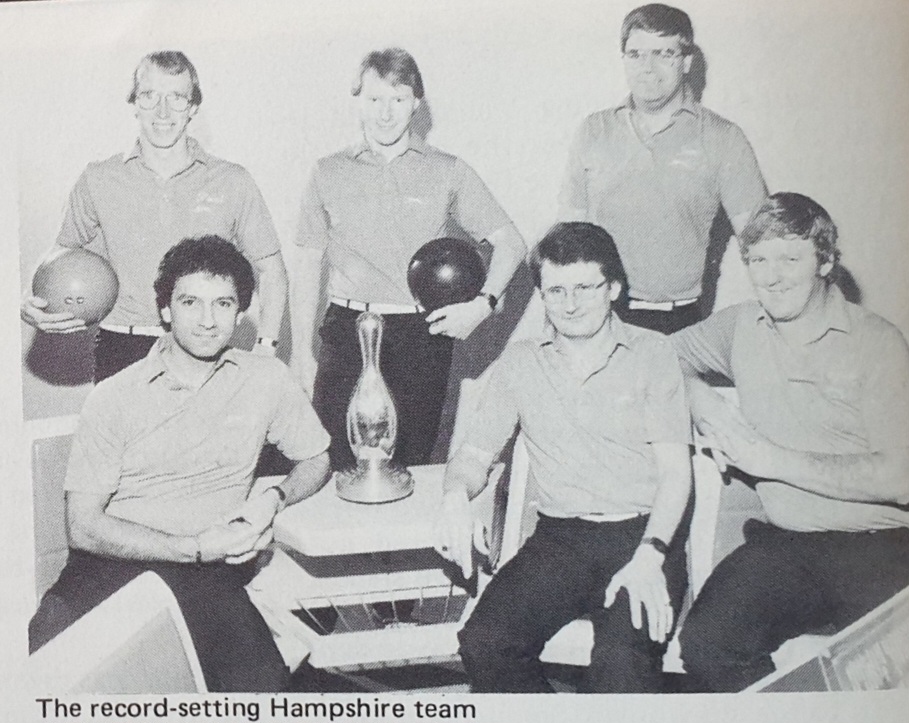
What else did you win as a youth then into adulthood and now senior age?
THE team to play for in Hampshire for many years was the Richmond Grill. I was invited to join them playing in both National and European team tournaments and helping them add to their many successes in doing so. The Paris Fives at Bowling de Paris was an epic tournament and venue the best tournament I ever played in.
Having been in the sport so long, which bowlers have impressed you the most both to compete against or watch?
I have been involved with Tenpin bowling for 57 years as a player, league official, tournament manager, county secretary, SICC secretary, tech, lane inspector and now Head of BTBA Tech services.
I have seen a lot of really good bowlers of all ages over those years far too many to mention. I am very much old school, one handed, far from a cranker and by modern ball speed of quite pedestrian pace. I was asked who impressed me when watching and also to compete against.
To watch is a tough one but in no particular order, Darren Cundy the smoothest bowler I have ever watched in person; Phil Scammell who bowled the toughest 300 I ever saw having to lob the ball several feet over destroyed headers in doing so; team mate Clive ‘ticky’ Thomas, a true gent. His epic 290, eleven in a row miss at Romford, “I knew the 12th was in trouble when I missed right when playing outside 1st arrow” he amusingly declared. Last in this all too short list is Dick Ritger the PBA Hall of Famer. After one of his coaching clinics, he demonstrated 5 consecutive strikes with no practice, first, second, third, fourth and then fifth arrow. on wood lanes in not exactly the best condition. He made it look so simple!
To compete against I have to be a little biased and close to home. You never want to be up against my stepdaughter Hayley Russell in a 10th frame shoot out. Her ability to pull it out the bag time after time under pressure never fails to impress me. She has done it since a junior in so many different events too.
Finally Paul, thank you for your service to bowling and one last question. Why should people try bowling and what has the sport given you in life?
I still thoroughly enjoy our sport and all aspects of it. I have made many numerous friends in and out of the game throughout. At any level its good exercise and in the main great fun competing. I would not have met my wife without it. She still bemoans me giving up the SICC secretary role which she helping me at the finals.
I wish more managers would try to encourage new bowlers in regular, hopefully league play. The many children who attend birthday parties could be told advised of the opportunity to be taught by joining a YBC. Regular income from leagues is a good reliable revenue stream too.